Urban Sustainability Data Analysis / Sub-page 2

Urban Sustainability Prediction Analytics Lab

A three-month online hackathon for building predictive analytics, interactive data visualizations, and scenario tools for sustainability performance during FIFA World Cup 2026 and future large events.

Sustainable Ecologies Installations Paris-Houston Sustainability Exchange Urban Sustainability Data Analysis Sustainability Best Practices
Rice World Cup Cities Hack flyer graphic with Houston skyline, Rice University branding, FIFA World Cup 2026 mark, and soccer ball

Data driven decision making

Urban Sustainability & Predictive Analytics

The hackathon is a data-management and visualization challenge for understanding the sustainability impacts of FIFA World Cup 2026 host cities through data and innovation.

We bring together Houston, Rice University, World Cup hosting, data graphics, mobility, public health, resource systems, and future-growth districts.

4challenge tracks
$17.5Ktotal prize platform
3 mo.analytics sprint

Three-month hackathon

Predictive tools for resource optimization and host-city readiness

The Prediction Analytics Lab is organized through the Rice University Urban Sustainability Hackathon on Devpost. Teams use FIFA World Cup 2026 as the case for asking how US cities can optimize sustainability performance while hosting large sporting events and other major gatherings.

Participants are challenged to combine data, maps, charts, models, and scenario comparisons into tools that help decision-makers and residents explore tradeoffs, identify priority areas, and understand measurable impacts over time.

Challenge Tracks, Prizes, And Team Disciplines

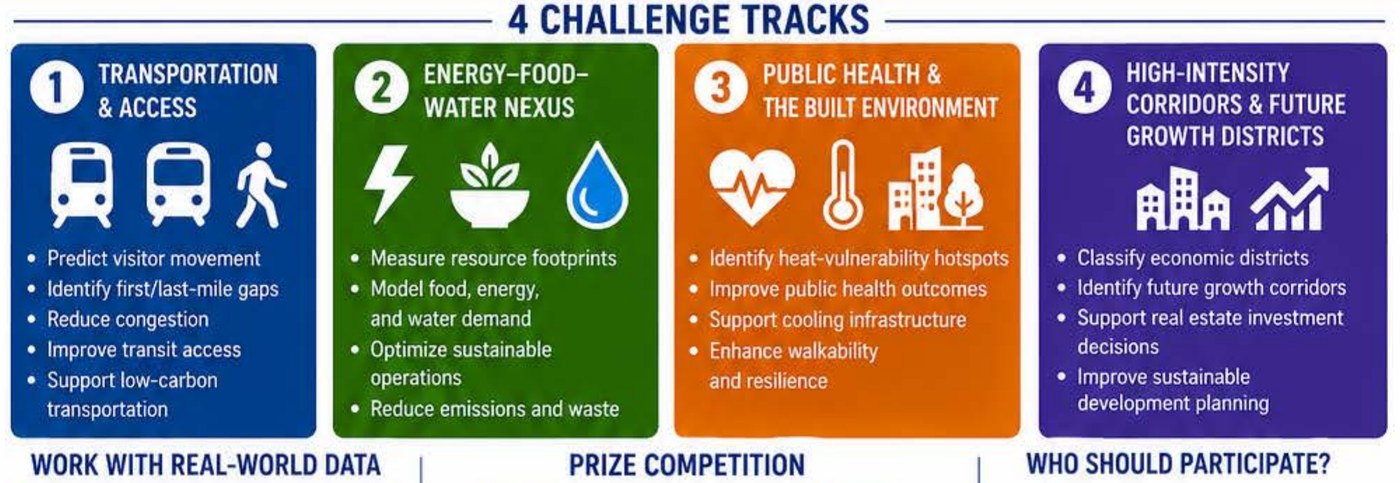
Four challenge tracks from the hackathon flyer: transportation and access, energy-food-water nexus, public health and built environment, and high-intensity corridors
Four challenge tracks connect predictive analytics with host-city sustainability decisions.
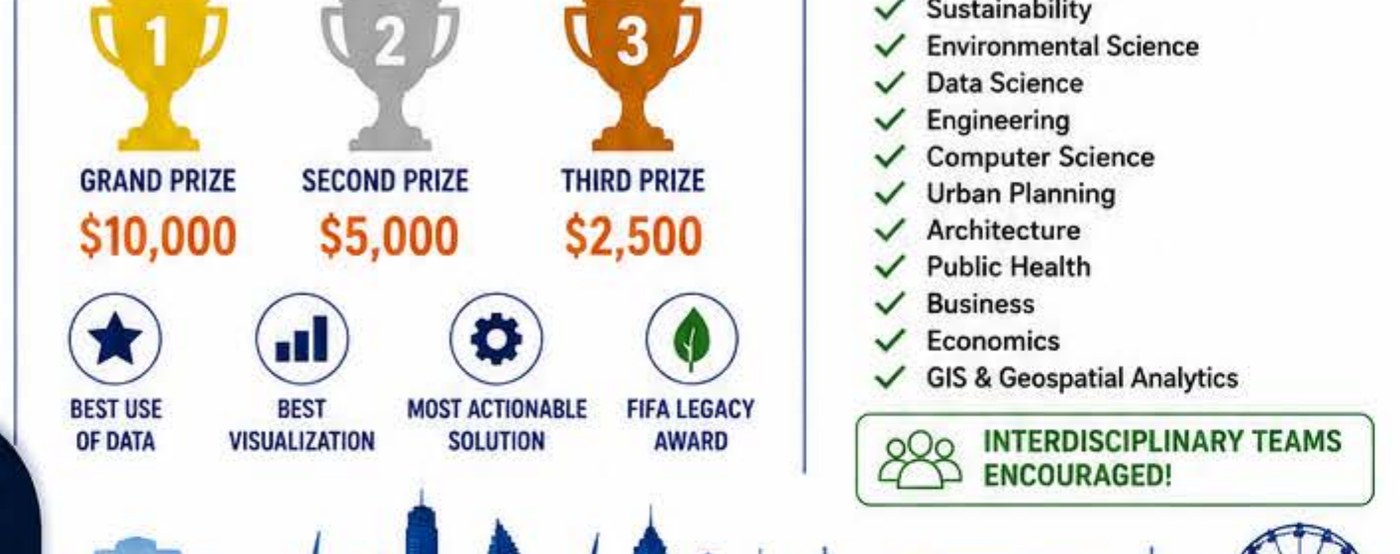
Prize competition and participant disciplines from the hackathon flyer
Prize categories and target disciplines emphasize data quality, visualization, actionability, and interdisciplinary participation.

Track 1: Transportation And Access

  • Predict visitor movement and first- and last-mile gaps.
  • Compare transportation resilience across host cities.
  • Recommend investments, transit solutions, and traffic management strategies.

Track 2: Energy-Food-Water Nexus

  • Quantify visitor, venue, hotel, and district resource footprints.
  • Visualize tradeoffs across all 11 US host cities.
  • Identify high-impact sustainability interventions.

Track 3: Public Health And Built Environment

  • Locate where visitor activity, urban heat, and climate risks overlap.
  • Support heat mitigation and public health interventions.
  • Translate climate risk into site-specific readiness actions.

Track 4: High-Intensity Corridors

  • Classify urban corridors, districts, and communities by economic intensity and mobility patterns.
  • Map land-use characteristics and development potential.
  • Identify future growth districts where sustainability planning can shape long-term outcomes.

Final Deliverables

  • A pitch for a solution that helps US cities optimize sustainability performance during major events.
  • An interactive data visualization with maps, charts, scenarios, and priority-area comparisons.
  • A practical recommendation that can inform city agencies, venues, transportation providers, developers, or event organizers.

Judging Lens

  • Impact, data analytics, innovation, feasibility, legacy, visualization quality, and presentation.
  • Evidence-backed reasoning that is spatially accurate, statistically sound, and clearly communicated.
  • Solutions that improve sustainability, resilience, mobility, resource efficiency, public health, or quality of life.

Why Prediction Analytics Matters

  • Major events compress visitor demand, resource use, mobility stress, and heat exposure into short windows.
  • Predictive tools help cities test scenarios before decisions become expensive or irreversible.
  • Reusable models can support long-term legacy outcomes beyond FIFA World Cup 2026.